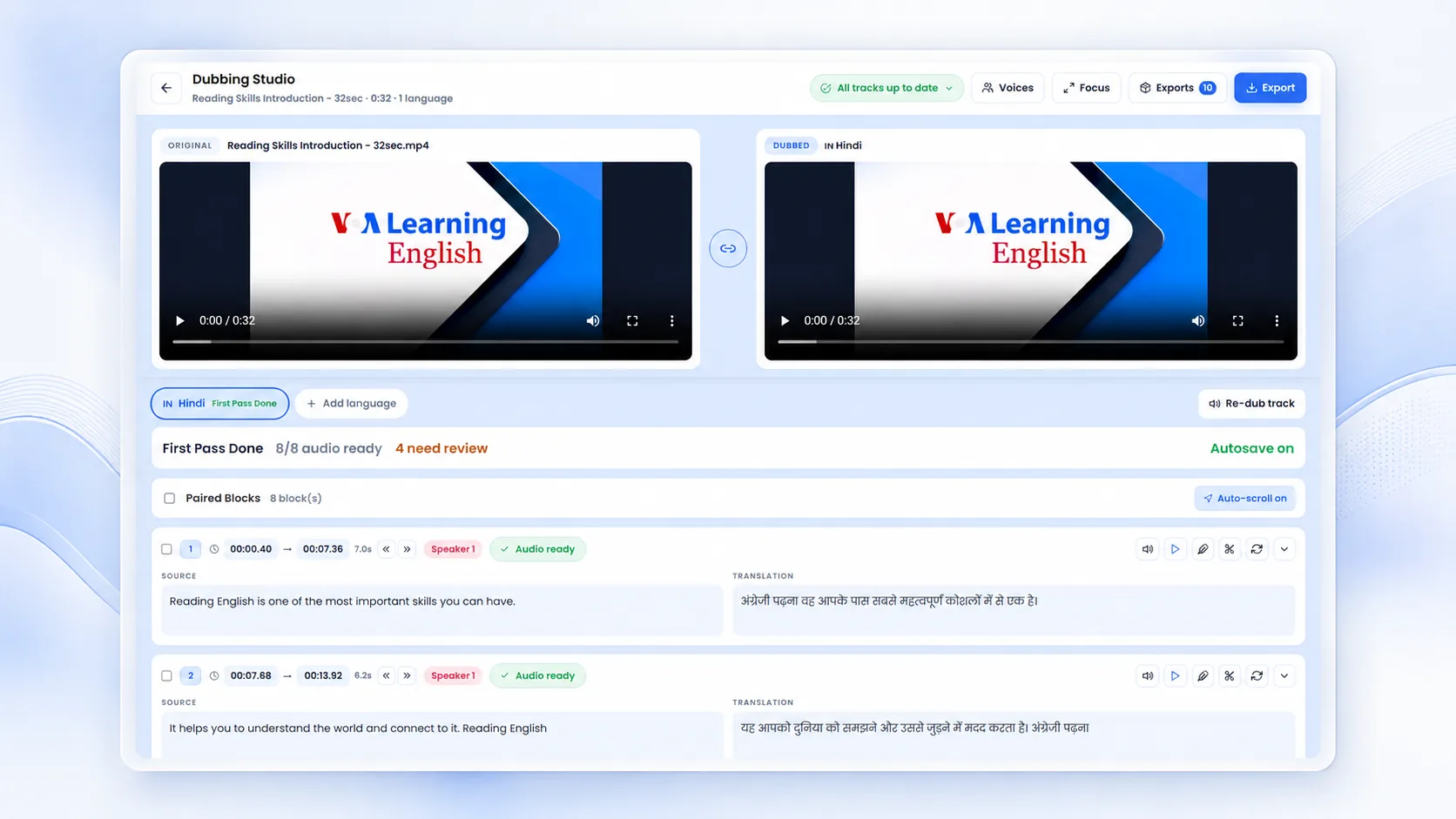
Workflow Course localization workflow

Course Video Localization in 100+ languages — narrated or dubbed

Two ways to take a course into 100+ languages from one project: narrate every lesson in the target language with the same instructor voice, or upload the videos you already recorded and dub them — translated, reviewed line by line, and exported with subtitles.

500M+ minutes generated Free trial, cancel anytime
Course localization workflow
Unmixr Dubbing Studio for course video localization

How it works

Pick the path that fits the course you have. Both end in the same place: every language version, with captions, from one project.

1

Bring the course in

Paste or import the lesson script and slides to narrate it in a new language — or upload the finished video to dub it. Unmixr splits either into editable, time-coded blocks.

2

Translate and review

Translate into each target language and fix terminology, names, and phrasing in the text before a single word is voiced. A correction made here is made once, for every version.

3

Cast the voice per language

Keep one instructor voice across every language, assign a voice per detected speaker in a dubbed video, or clone an approved trainer with consent in 80+ languages.

4

Export every version

Download lesson audio or narrated MP4 for the narrated path, the dubbed video and audio track for the dubbed path, and SRT or VTT subtitles for both — ready for your LMS.

Two ways to localize a course

Narrate it again in the target language, or dub the video you already recorded. Both run in the same studio, and both end with subtitles and an LMS-ready export per language.

Path 1 · Narrate

Narrate the course in a new language

For courses built from scripts, slides, or documents — or any course you want to sound native rather than dubbed.

  • Translate the lesson script and keep the same instructor voice in every language, so learners in Madrid and Tokyo enrol with the same teacher.
  • Slides become a narrated MP4 per language; script-only lessons export as audio with captions and a transcript.
  • Pronunciation rules for product names and technical terms hold across every language version.
  • When a lesson changes, regenerate the one block that changed in each language instead of re-recording anything.
Path 2 · Dub

Dub the course videos you already recorded

For screen recordings, talking-head lessons, and any video library that already exists — the footage stays, the speech changes.

  • Upload the video: Unmixr transcribes it, detects the speakers, and translates the transcript into editable, time-coded segments.
  • Review every translated line before it is voiced, then assign a voice per speaker or clone the original trainer with their consent.
  • Dubbed segments follow the original timing; tighten any line that runs long in the target language and regenerate just that segment.
  • Export the dubbed MP4 or audio track with translated subtitles, per language, as each one is approved.
Narrated path, heard

One lesson, six languages, one instructor.

The same personal-finance lesson narrated in six languages by one course instructor — the script translated once, reviewed, then voiced. Every script is printed beside the audio; headphones recommended.

  • Original generated audio
  • Scripts included
  • No sign-up to listen
Path 1 · Narrate

One finance lesson. Six languages. The same instructor.

The narrated path, heard: the same lesson from a personal-finance course in English, Spanish, French, Japanese, Arabic, and Hindi, read by one course instructor. The language changes; the teacher your learners enrolled with does not.

100+ languages available

Can a localized course keep the same narrator in every language? Yes — translate the lesson script, keep one instructor voice across every version, and publish each locale with its own captions. That is what these six clips are.

Ada Course instructor
Same voice

English

Before you invest anything, build the boring thing first: three months of expenses, in an account you can reach the same day. It is not the exciting lesson. It is the one that makes every lesson after it survivable.

Unmixr AI Voice
0:17
Ada Course instructor
Same voice

Spanish

Antes de invertir nada, construye primero lo aburrido: tres meses de gastos, en una cuenta a la que puedas acceder el mismo día. No es la lección emocionante. Es la que hace que todas las siguientes sean soportables.

Unmixr AI Voice
0:17
Ada Course instructor
Same voice

French

Avant d'investir quoi que ce soit, commencez par la partie ennuyeuse : trois mois de dépenses, sur un compte accessible le jour même. Ce n'est pas la leçon la plus excitante. C'est celle qui rend toutes les suivantes supportables.

Unmixr AI Voice
0:13
Ada Course instructor
Same voice

Japanese

投資を始める前に、まずは地味な土台をつくりましょう。生活費の三か月分を、その日のうちに引き出せる口座に置いておくことです。派手なレッスンではありません。ですが、この先のすべてを乗り切れるようにしてくれます。

Unmixr AI Voice
0:16
Ada Course instructor
Same voice

Arabic

قبل أن تستثمر أي شيء، ابدأ بالجزء الممل: مصاريف ثلاثة أشهر، في حساب تستطيع الوصول إليه في اليوم نفسه. ليس هذا هو الدرس المثير، لكنه الدرس الذي يجعل كل ما يليه ممكناً.

Unmixr AI Voice
0:14
Ada Course instructor
Same voice

Hindi

निवेश शुरू करने से पहले वह उबाऊ काम कीजिए: तीन महीने का ख़र्च, ऐसे खाते में जहाँ से उसी दिन पैसे निकाले जा सकें। यह रोमांचक पाठ नहीं है। यही वह पाठ है जो आगे के हर पाठ को टिकाऊ बनाता है।

Unmixr AI Voice
0:15

Six are playable here; the same lesson can be narrated and captioned in 100+ languages from the one project. The script was translated once and reviewed before a word was voiced.

Narrate a lesson in a new language
Course localization

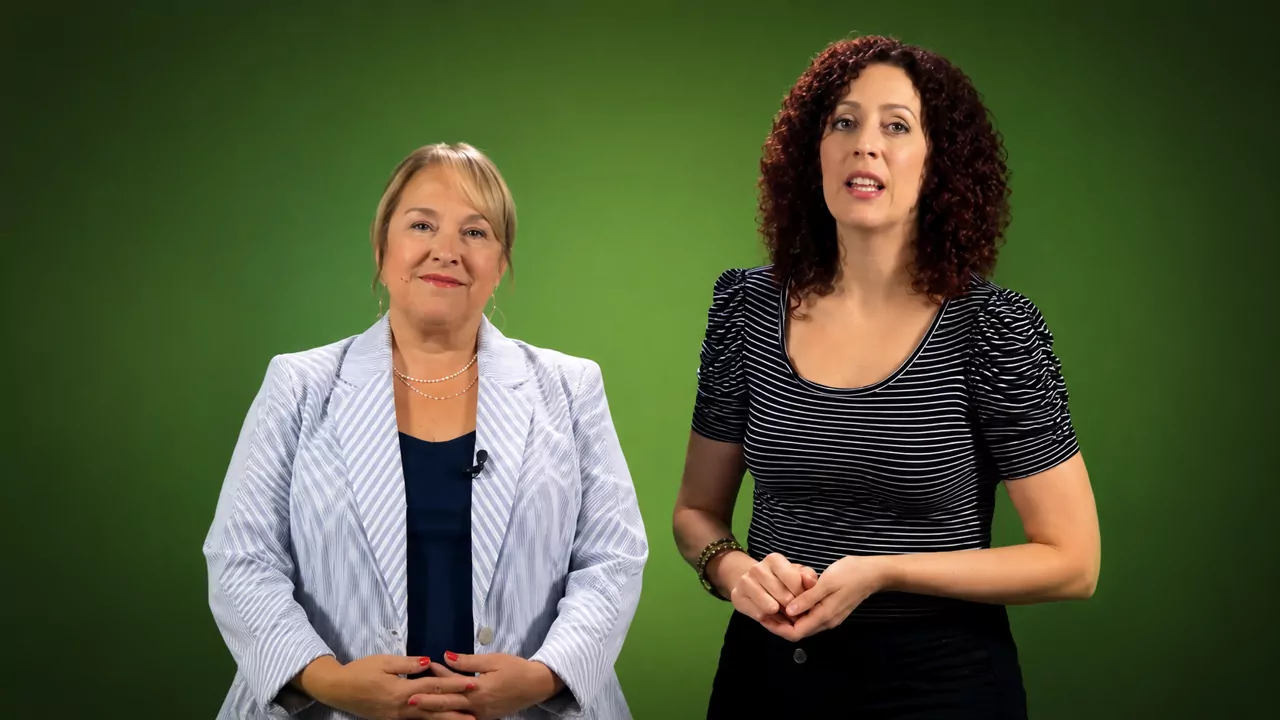
One recorded session, every region's version.

A single on-camera training clip, dubbed with Unmixr. Switch languages while it plays and judge the timing, tone, and pronunciation the way your regional reviewers will.

app.unmixr.com/dubbing
Two presenters on camera in the Unmixr dubbing example clip English
Hear it in:

Narrate or dub? A side-by-side

The honest answer is "it depends on what you start with". This is the comparison teams use to decide per course — and many libraries end up using both.

Question Narrate the course again Dub the recorded video
Start from A lesson script, slide deck, or document — or a course you are still writing. A finished video: screen recording, talking-head lesson, webinar replay.
What the learner hears The course spoken natively in their language by the instructor voice you chose. The original video with the speech replaced in their language, background audio kept where your plan supports it.
Video output A new narrated MP4 per language when the lesson has slides; audio plus captions otherwise. The same video file with a new audio track and subtitles, per language.
Best for New courses, slide-based modules, and libraries you want to sound native everywhere. Existing video libraries, recorded lectures, and anything with on-screen demonstrations.
Updating a lesson later Edit the block, regenerate it in each language. Re-dub the changed segment; the rest of the track keeps its approved audio.
Credits One credit per character of narration. 1,920 credits per dubbed minute — about 260 minutes on Starter.

Credits are one pool: spend them on narration, dubbing, or transcription in any mix. Figures reflect current plans — check the pricing page before you buy.

Everything this workflow needs

Built for global L&D teams, online schools, educators, and product training teams — voice, video, subtitles, transcription, and dubbing in one place.

One instructor, every language

Narrate the same lesson in 100+ languages with a consistent instructor character, so the course sounds like one teacher everywhere. The six-language demo on this page is one narrator, not six.

Transcribe the video you have

Upload a recorded lesson and get editable, time-coded segments with speakers detected. Fix names and terminology once, before translation, so an error never multiplies across languages.

Translation you review first

Every translated line is text you can edit, split, or merge before it is voiced — in both paths. Your subject-matter terms survive the handoff to each region.

Dubs that keep the footage

The dubbed path replaces the speech track and adds subtitles; the video, on-screen demos, and timing stay as recorded. Segments stay editable so a line that runs long in German can be tightened on its own.

Subtitles with every version

SRT and VTT captions export alongside the narration or the dub in each language, or on their own for a subtitles-only localization.

One project per course

Every language version of a course lives in the same project. When the source lesson changes you know exactly which versions to refresh — and you regenerate a block, not a course.

Where teams use this workflow

Real jobs-to-be-done, each connected to the Unmixr studio that handles it.

Online course catalogs

Republish a paid course in the languages your enrolments already come from, narrated by the same instructor voice.

See course narration →

Onboarding and compliance modules

Roll out the same mandatory module to every region — dub the recorded version or narrate the slide deck per language.

See training videos →

Software walkthroughs and recorded lectures

Keep the screen recording exactly as it is and dub the speech, so the UI on screen still matches what the voice says.

Explore AI dubbing →

Subtitles-only localization

Transcribe a lesson, translate the transcript, and ship captions in every language for learners who prefer to read along.

Transcribe your media →
500M+
Minutes of audio and video generated by creators worldwide
100+
Languages across voiceover, transcription, subtitles, and dubbing
80+
Voice-cloning languages for a consistent brand narrator
FAQ

Course Video Localization: your questions, answered

Straight answers for teams evaluating this workflow.

What is the best way to localize an online course?

There are two, and the right one depends on what you start with. If the course exists as scripts, slides, or documents, narrate it again in each language with the same instructor voice — it sounds native and every lesson stays editable. If the course already exists as recorded video, dub it: transcribe, translate, review, voice, and export with subtitles, leaving the footage untouched. Unmixr runs both paths in one browser-based studio, in 100+ languages, and most teams end up using each where it fits.

Can I narrate a course in multiple languages with the same voice?

Yes. Translate the lesson script, keep one instructor voice across every version, and export each language with its own captions. The six-language demo on this page is one personal-finance lesson read by the same narrator in English, Spanish, French, Japanese, Arabic, and Hindi. Where you have permission, an approved trainer's voice can also be cloned in 80+ languages so the course keeps a real instructor's identity abroad.

Can Unmixr dub my existing course videos into other languages?

Yes. Upload the video and Unmixr transcribes it, detects the speakers, and translates the transcript into time-coded segments. You review every line, assign a voice per speaker (or clone the original trainer with consent), generate the dub, and export the dubbed MP4 or audio track with translated subtitles. Videos up to 60 minutes are accepted per upload; longer courses are dubbed lesson by lesson, which is how course libraries are organised anyway.

Should I narrate or dub my course?

Narrate when the course is built from slides, scripts, or documents, when you want it to sound native, or when you expect to keep editing it — a changed block is regenerated per language in minutes. Dub when the course already exists as video, especially screen recordings and demonstrations where the visuals must stay exactly as recorded. The comparison table on this page lays the two paths side by side.

How many languages can I localize a course into?

100+ languages across narration, transcription, translation, subtitles, and dubbing, with 150+ regional accents to match a learner base. Voice cloning covers 80+ languages. The practical limit is review time per language, not the platform — every translated line is worth a subject-matter read before it goes live.

Will the dubbed audio stay in sync with my video?

Yes. Dubbing works on time-coded segments that follow your original speech, with a choice of fixed or natural duration per segment, and each one stays editable so you can tighten a line that runs long in the target language. Unmixr replaces the speech track and adds subtitles; it does not re-animate the on-screen speaker's lips.

Does dubbing keep the background music and sound effects?

On paid recurring plans, yes: the original speech is separated from the background before the dub is mixed, so music and room sound stay while the voice changes. This separation is not available during the free trial, where dubs are voices-only. You can also keep the original audio for individual segments — a product demo's click sounds, say — and dub the rest.

Can I edit the translation before anything is voiced?

Yes, in both paths. Translation is a reviewable text step: fix terminology, names, and phrasing, split or merge segments where a sentence lands differently in the target language, then generate. After generating, edit any line and regenerate only that block or segment — the rest keeps the audio you already approved.

Do I get subtitles with each language version?

Yes. SRT and VTT captions export alongside the narration or the dub in every language, and the dubbed path can also burn captions into the video. If you only need captions, transcribe the lesson, translate the transcript, and export the subtitle files without dubbing at all.

What can I export for my LMS?

Narrated path: MP3 lesson audio, a narrated MP4 when the lesson has slides, SRT and VTT captions, and a text transcript per language; course projects can also be packaged as SCORM (1.2 and 2004) on any paid plan. Dubbed path: the dubbed MP4, the dubbed audio track, translated subtitles, and a per-language bundle you can hand to a video team.

How much does course localization cost?

It depends on the path. Narration is one credit per character, so a ten-minute lesson of about 1,500 words costs roughly 9,000 credits per language. Dubbing is 1,920 credits per minute of video. Starter is $19/month with 500K credits every month — about 260 dubbed minutes or several hours of narration — Pro is $49/month and Business $99/month for larger catalogs, and every paid plan includes full commercial rights.

Is there a free trial?

Yes. The 7-day trial includes 20,000 credits — start it in one click, and cancel anytime before it ends; nothing is charged during the trial. During the trial, uploads for dubbing are trimmed to their first five minutes and finished media exports unlock when the plan activates. The free account comes with 5,000 credits and no trial at all — enough to narrate a lesson or dub a couple of minutes and hear the result, with watermarked exports up to three minutes.

How long does it take to localize a course?

Generation is minutes per lesson in either path — a translated script narrates almost immediately, and a ten-minute video dubs in the background while you work on the next one. The time that matters is review: plan a subject-matter pass over each language's transcript before it goes live. Teams usually localize a pilot lesson in an afternoon and then batch the rest.

Do I need to re-edit my video for every language?

No. On the dubbed path, the visuals stay untouched — each language version swaps in the localized speech track and subtitles over the same video file. On the narrated path, the slides render once per language with the new narration timed to them automatically.

Can I use the localized courses commercially?

Yes. On any purchased plan, every narration and dub you generate is 100% cleared for commercial use — paid courses, client work, and internal training alike. The one rule that always applies is consent: only clone a voice you own or have written permission to use.

Take your best course global — narrated or dubbed

Bring one lesson, pick the path that fits it, and hear it in a second language before you decide anything about the rest of the catalog.

Localize a Course

Free account to start · Plans from $9/month · 100+ languages

Still have a question?

If you have a specific use case or need help configuring a custom workflow, our team is always here for you. We would love to listen to your needs!